Unifying network connectivity from geodesics to random walks via the random cluster model
Jun 27, 2026·
,
,
 ,
,
,
·
0 min read
,
,
,
·
0 min read
Xiangyi Meng
Chenxuguang Zhu
Nicola Pedreschi
Dr. Erik Hormann
Duxin Chen
Gaogao Dong
Renaud Lambiotte
Abstract
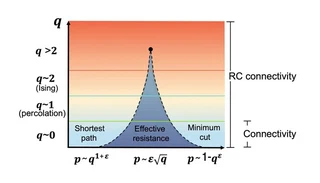
Connectivity is a fundamental concept in network science, characterizing how interactions propagate through indirect pathways. While numerous connectivity metrics exist, such as shortest paths, effective resistance and minimum cut, each highlighting distinct structural features, their relationships remain largely fragmented. Here we show that these classical notions arise as limiting cases of a unified statistical-physics framework based on the random cluster (RC) model, which interprets connectivity as a principled synthesis of series and parallel transmission. By tuning its parameters, the RC model not only recovers classical connectivity measures but also extrapolates into unexplored regimes, leading to emergent notions of connectivity which yield practical tools for network learning tasks. In particular, RC connectivity naturally encodes the kinetics of growing paths, enhancing learning performance in dynamical settings such as epidemic spreading and neurodynamics. By linking structural, dynamical, and learning-based perspectives, RC connectivity establishes a general and interpretable foundation for the analysis of networked systems.
Type
Publication
Nature Communications
Status
Peer-reviewed
Open access

Authors
Dr. Erik Hormann
(he/him)
Lecturer in Mathematics
I am a Lecturer in Mathematics at James Cook University Singapore.
My research focuses on network science, stochastic processes, and
statistical mechanics, with particular interests in random walks on
complex networks, network dynamics, and network coarse-graining.
I am also interested in mathematical education and the development
of new approaches to university mathematics assessment.